
The Face of a Vesuvius Victim, Reconstructed Nearly 2,000 Years Later
30 April 2026
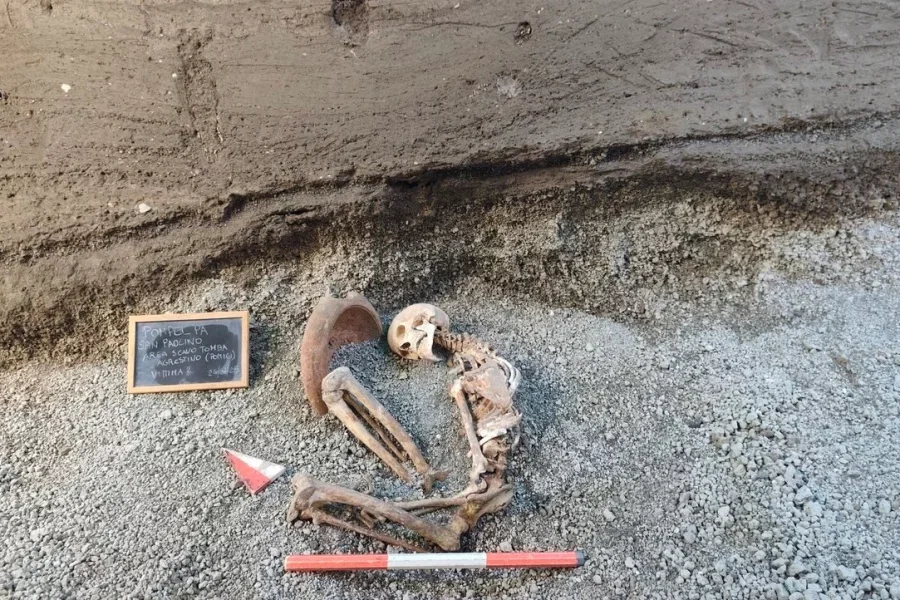
A victim of the AD 79 eruption of Mount Vesuvius, photographed at the archaeological site of Pompeii, near Naples in southern Italy. Image released by the Italian Culture Ministry on April 27, 2026. AP/Italian Culture Ministry
For the first time, archaeologists used artificial intelligence to digitally reconstruct the face of a victim of the 79 AD eruption of Mount Vesuvius, putting a human face to one of history's most famous tragedies.
When Mount Vesuvius erupted in AD 79, Pompeii was buried in just a few hours. The remains of thousands of people were preserved under ash and pumice, frozen in time. Now, almost two thousand years later, archaeology and artificial intelligence have worked together to put a face to one of those stories.
The initial artificial intelligence-generated face reconstruction of a victim of the eruption was made public by the Pompeii Archaeological Park, in collaboration with the University of Padua and the Italian Culture Ministry. The portrait shows an older man attempting to flee along the road leading to the coast, holding a terracotta mortar over his head as a makeshift shield against the volcanic rocks raining down from the sky. He was not alone: the remains of another person were found beside him. The Roman writer Pliny the Younger had already described residents using objects to shield themselves during the eruption, and this find confirms it. Near the man lay an oil lamp, a small iron ring, and ten bronze coins, objects that paint, in telling detail, a picture of everyday life in the city before it was lost.
To achieve this reconstruction, researchers used data from the skeleton found near the Porta Stabia, one of the ancient city's gates. They developed the lifelike image by applying AI and photo-editing techniques to translate archaeological data. Crucially, the goal of this effort goes beyond technological innovation: giving a human face to this data is a way to bring the public closer to archaeological research in ways that skeletons and figures rarely can.
Gabriel Zuchtriegel, the park's director, put it well: the volume of archaeological data accumulated today is now so vast that only with the help of artificial intelligence will it be possible to do justice to this heritage, and, used wisely, that technology can breathe new life into classical studies, making the past more vivid and accessible to everyone.
—
Read the full story on NPR for more on the reconstruction.
See Also

Copyright © 2025 | Universo Inspira