
Guided Learning
The Cell as a Factory
Area: Science
Theme: Eukaryotic Cells
Grade: 7th grade
Estimated time: ⏱️ 2 classes
🔍 Investigation · 🧫 Cell Biology
Letter to the User
Guided Learning – Inspire Universe
Welcome to Inspire Universe's Guided Learning.
The Guided Learning tracks were created to help you organize your studies, deepen your understanding of the content, and turn scientific concepts into hands-on learning experiences.
Each track brings together structured activities, experiments, challenges, reflections, and investigative tasks that can be used in two ways:
- By the teacher, as a support tool for planning and delivering classroom activities;
- By the student, as a step-by-step study guide for learning inside and outside of school.
Here, learning goes beyond watching or reading: you are invited to observe, test, measure, compare, calculate, reflect, and connect ideas — developing essential scientific skills such as critical thinking, curiosity, and intellectual independence.
The activities were organized into thematic tracks, written in clear, accessible language, and designed to accompany you at every stage of your learning path, from your first contact with the topic to mastering the content.
At the end of each track, we invite you to keep exploring:
- completing the quizzes available in the app,
- revisiting the digital content,
- and deepening your understanding of the Universe and the scientific phenomena that surround us.
About the Use of This Material
This material is made available exclusively for educational use within the Inspire Universe platform.
Reproduction, distribution, commercialization, or sharing of this content, in whole or in part, by any means, without express authorization, is prohibited.
The responsible use of this material ensures that the educational, editorial, and scientific work involved in its creation is properly valued and allows us to continue developing new tracks, content, and learning experiences for you.
Evobooks Team
What will you learn?
By the end of this lesson, you will be able to understand what eukaryotic cells are, identify their main structures, understand the function of each organelle, distinguish between prokaryotic and eukaryotic cells, and recognize the types of living organisms made up of eukaryotic cells.
Why does this matter?
Cells are the foundation of all living things. Understanding how a cell works makes it easier to grasp how the human body, plants, fungi, and other organisms carry out their functions. This knowledge helps you appreciate the importance of cellular balance and the care we must take with the environment.
Step 1 — Exploring
Zooming In
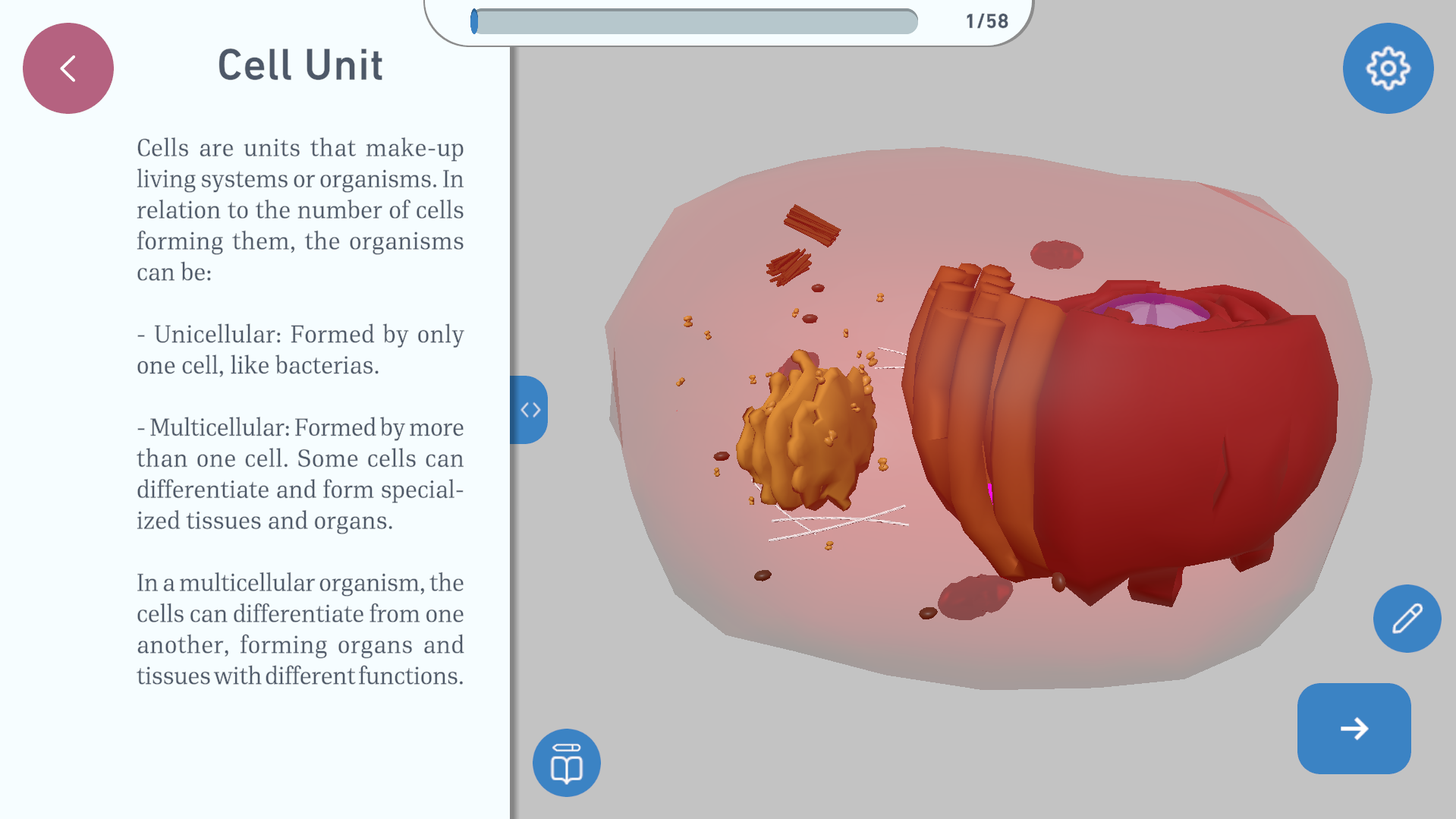
Observe the 3D model of a cell in the app. Use the visualization to identify:
- Different parts inside the cell.
- Structures that seem to carry out specific functions.
Reflect:
- In what types of organisms do we find cells like this one?
- Do all cells have the same internal organization?
💡 Teacher's tip:
Encourage students to describe what they observe before any theoretical explanation is introduced.
Step 2 — Investigating
Cell Types and Cellular Organization
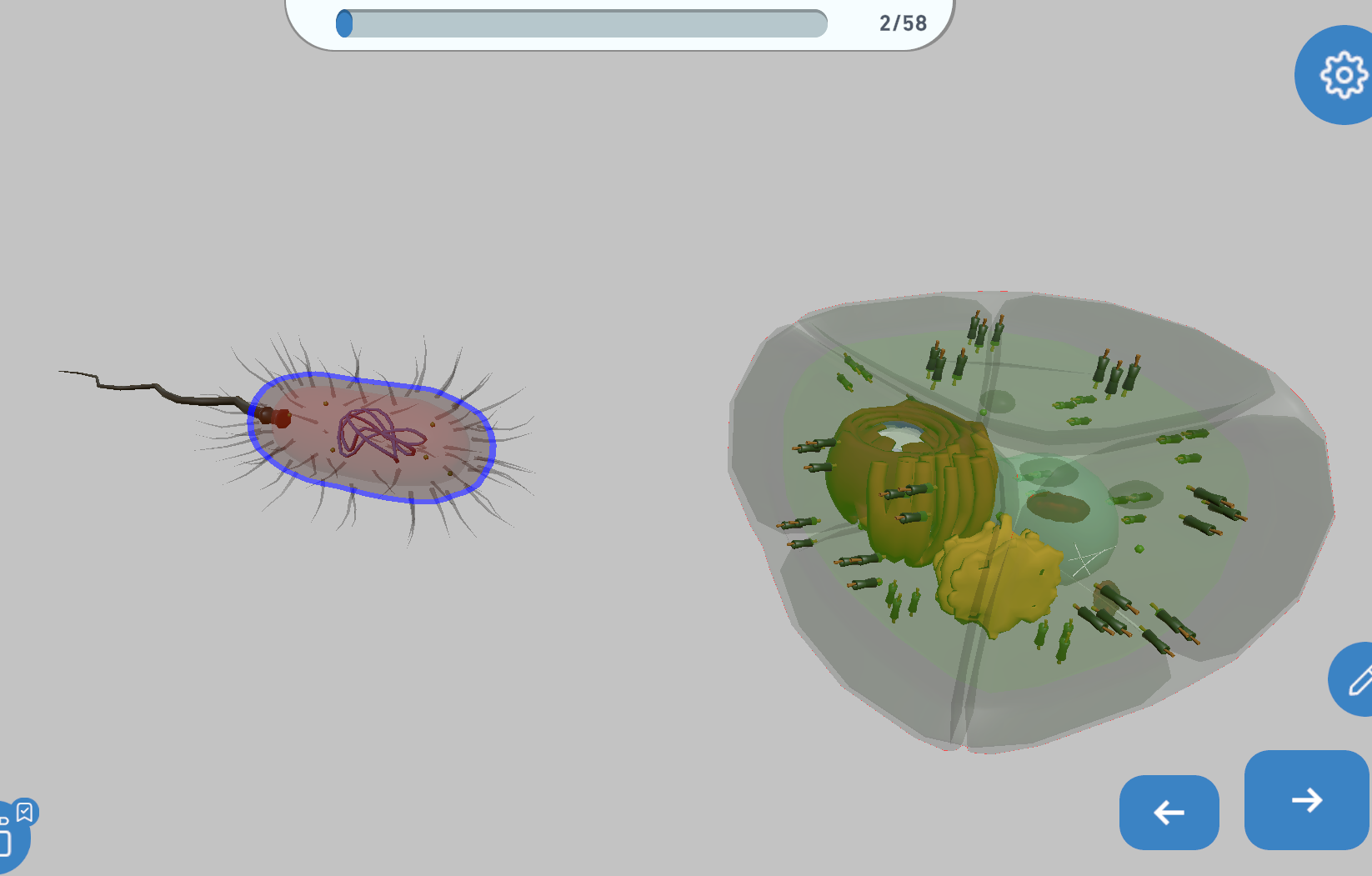
Based on your observations, investigate the two major groups of cells: prokaryotic and eukaryotic.
Answer:
- What would be an example of a prokaryotic organism?
- What would be an example of a eukaryotic organism?
Now, look at the 3D model again:
- Which structures are found only in eukaryotic cells?
- What does the presence of organelles tell us about how the cell functions?
With these observations in mind, try to answer: what fundamentally distinguishes these two types of cells?
⌛To help you think
Cell types:
- Prokaryotic cells: have no defined nucleus. Example: bacteria.
- Eukaryotic cells: have a defined nucleus and contain several organelles. Example: animal and plant cells.
Using the 3D model in the app, explore the following structures of the eukaryotic cell:
- Nucleus
- Plasma membrane
- Mitochondria
- Ribosomes
- Endoplasmic reticulum
- Golgi apparatus
- Lysosomes
- Vacuoles
- Chloroplasts (plant cells)
- Cell wall (plants, algae, and fungi)
💡 Teacher's tip:
Return to examples such as bacteria, plant cells, and animal cells, as indicated in the original lesson plan.
Step 3 — Building Concepts
Cell Structures and Their Functions
You have already distinguished between prokaryotic and eukaryotic cells; now it is time to deepen the analysis.
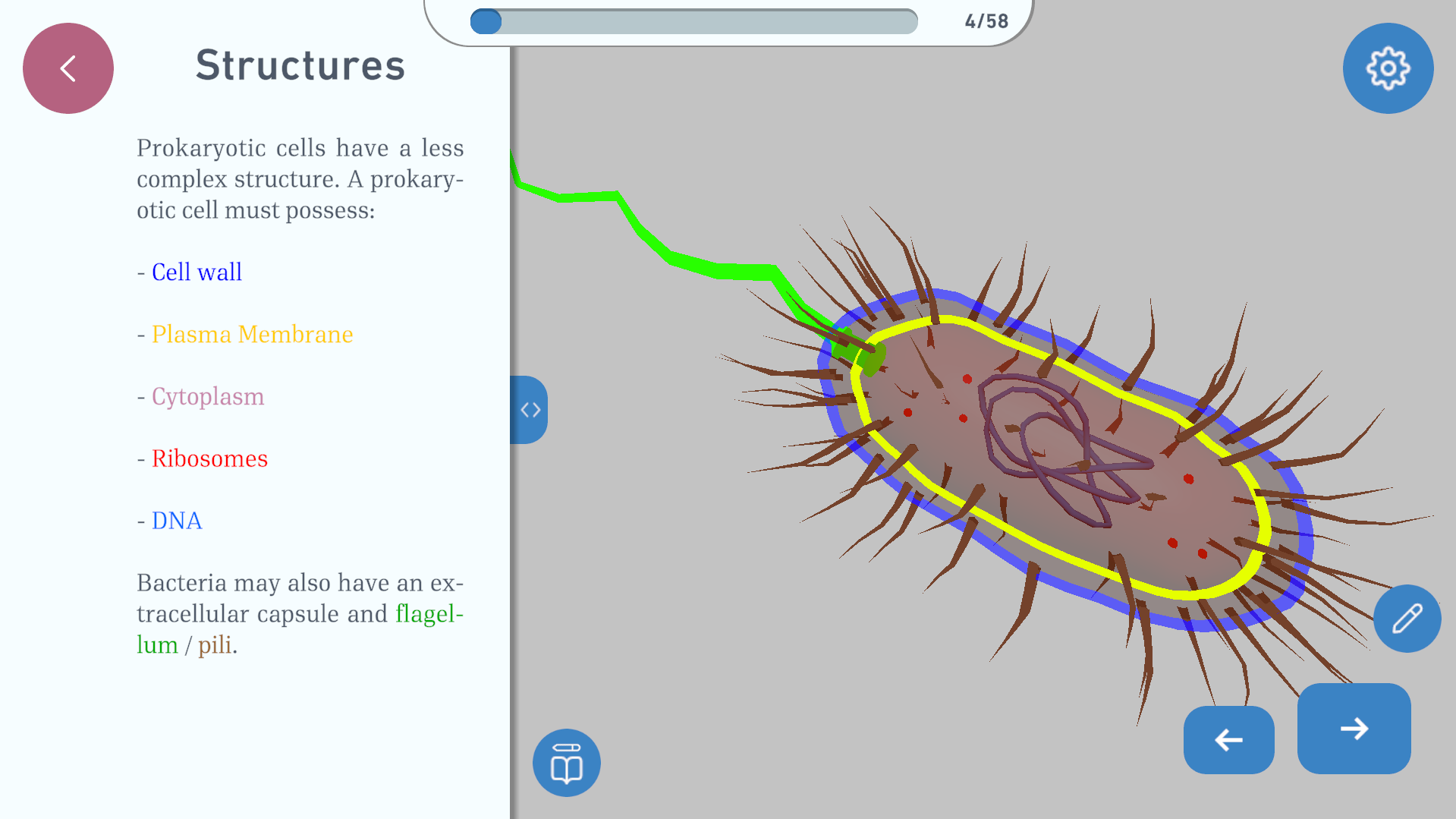
Observe the 3D model of the eukaryotic cell and notice that the inside of a cell is not an empty space. It is made up of different structures, called organelles, each with a specific function.
To guide your observation:
- What structures appear inside the cell?
- Do they all carry out the same function?
- What would happen if one of them stopped working?
💡 Teacher's tip:
Guide the observation by connecting structure to function, without anticipating the analogy. Encourage students to explain the role of each organelle in their own words.
Step 4 — Connecting the Dots
The Cell as a Country
Now that you know the structures of the eukaryotic cell and understand the function of each organelle, it is time to connect this knowledge to something from everyday life.
Imagine that a cell works like a country. Just as a country needs organization to function well, a cell also depends on each structure carrying out its role correctly.
Look at the organelles again and think:
- Which structure is responsible for coordinating the cell's activities?
- Which structure provides the energy for everything to work?
- Which structures are involved in the transport, production, and storage of substances?
Analyze each cell structure and connect its function to a component of a country. Fill in the table by drawing a parallel between:
- The cell structure.
- The function it carries out.
- The corresponding part of a country.
Use your own words. Think about the function before thinking about the comparison.
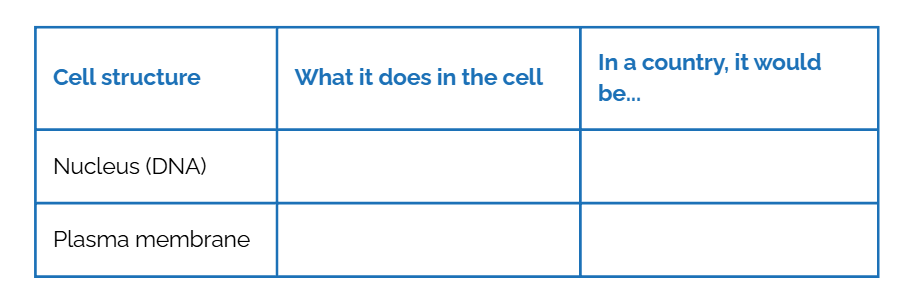
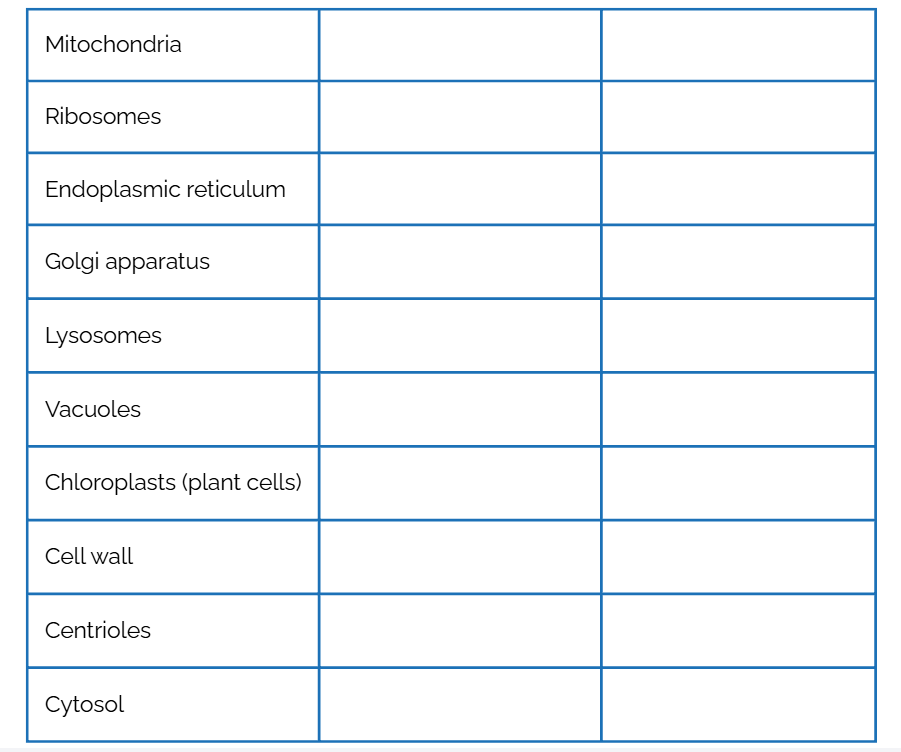
After completing the table, reflect:
- Why can this structure be compared to that part of the country?
- What would happen to the country if that sector stopped functioning?
- What would happen to the cell if that organelle did not exist?
💡 Teacher's tip:
Divide the class into groups of up to five students and encourage collective discussion before filling in the table. Ask students to justify their choices, valuing the reasoning process rather than just the final answer.
Suggested answers
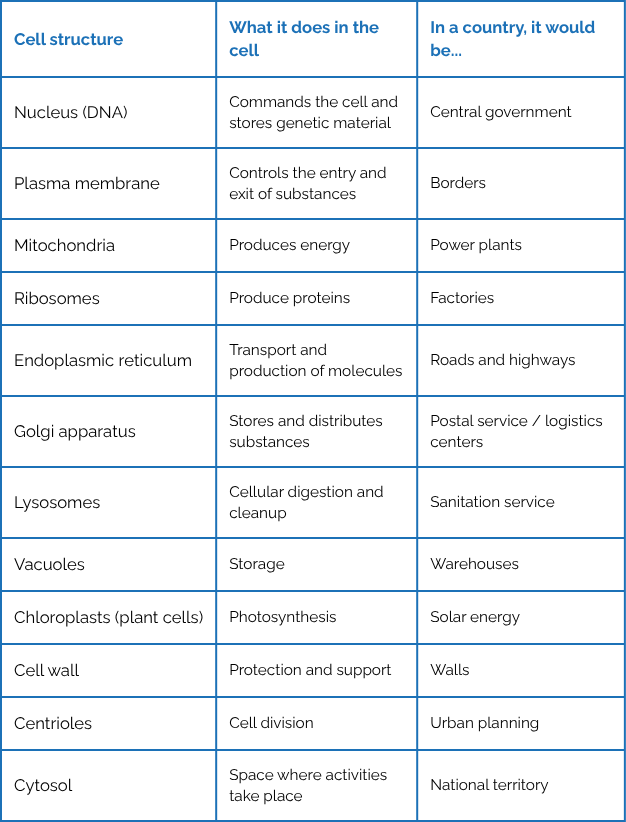
Throughout this Guided Learning experience, you:
- Explored the organization of eukaryotic cells.
- Investigated their main structures and functions.
- Distinguished between prokaryotic and eukaryotic cells.
- Connected the cell to organized systems from everyday life.
Now that you understand how a cell works, can you see how this organization supports life in all living organisms?
👉 Want to keep learning?
Access the quizzes in the app and deepen your knowledge about cells and their structures on Inspire Universe.
This material is protected by copyright. Reproduction, distribution, or sharing, in whole or in part, without authorization from Inspire Universe, is prohibited under Brazilian Copyright Law (Law No. 9,610/1998).

Copyright © 2025 | Universo Inspira