
Guided Learning
Understanding Our Respiratory System
Area: Science
Theme: The Respiratory System
Grade: 8th grade
Estimated time: ⏱️ 2 classes
👁️ Observation · 🔍 Investigation
Letter to the User
Guided Learning – Inspire Universe
Welcome to Inspire Universe's Guided Learning.
The Guided Learning tracks were created to help you organize your studies, deepen your understanding of the content, and turn scientific concepts into hands-on learning experiences.
Each track brings together structured activities, experiments, challenges, reflections, and investigative tasks that can be used in two ways:
- By the teacher, as a support tool for planning and delivering classroom activities;
- By the student, as a step-by-step study guide for learning inside and outside of school.
Here, learning goes beyond watching or reading: you are invited to observe, test, measure, compare, calculate, reflect, and connect ideas — developing essential scientific skills such as critical thinking, curiosity, and intellectual independence.
The activities were organized into thematic tracks, written in clear, accessible language, and designed to accompany you at every stage of your learning path, from your first contact with the topic to mastering the content.
At the end of each track, we invite you to keep exploring:
- Completing the quizzes available in the app.
- Revisiting the digital content.
- Deepening your understanding of the Universe and the scientific phenomena that surround us.
About the Use of This Material
This material is made available exclusively for educational use within the Inspire Universe platform.
Reproduction, distribution, commercialization, or sharing of this content, in whole or in part, by any means, without express authorization, is prohibited.
The responsible use of this material ensures that the educational, editorial, and scientific work involved in its creation is properly valued and allows us to continue developing new tracks, content, and learning experiences for you.
Evobooks Team
What will you learn?
You will be able to identify the main organs of the respiratory system and their functions, understand how inhalation and exhalation occur, recognize the importance of breathing for sustaining life, and connect the functioning of the respiratory system to everyday situations, such as smoking and respiratory diseases.
Why does this matter?
Breathing is one of the most fundamental processes of life; we do it about 20,000 times a day, almost always without noticing. Understanding how this system works helps you better understand your body, take care of your health, and make more informed decisions in your daily life.
Step 1 — Exploring
Connecting to the Real World
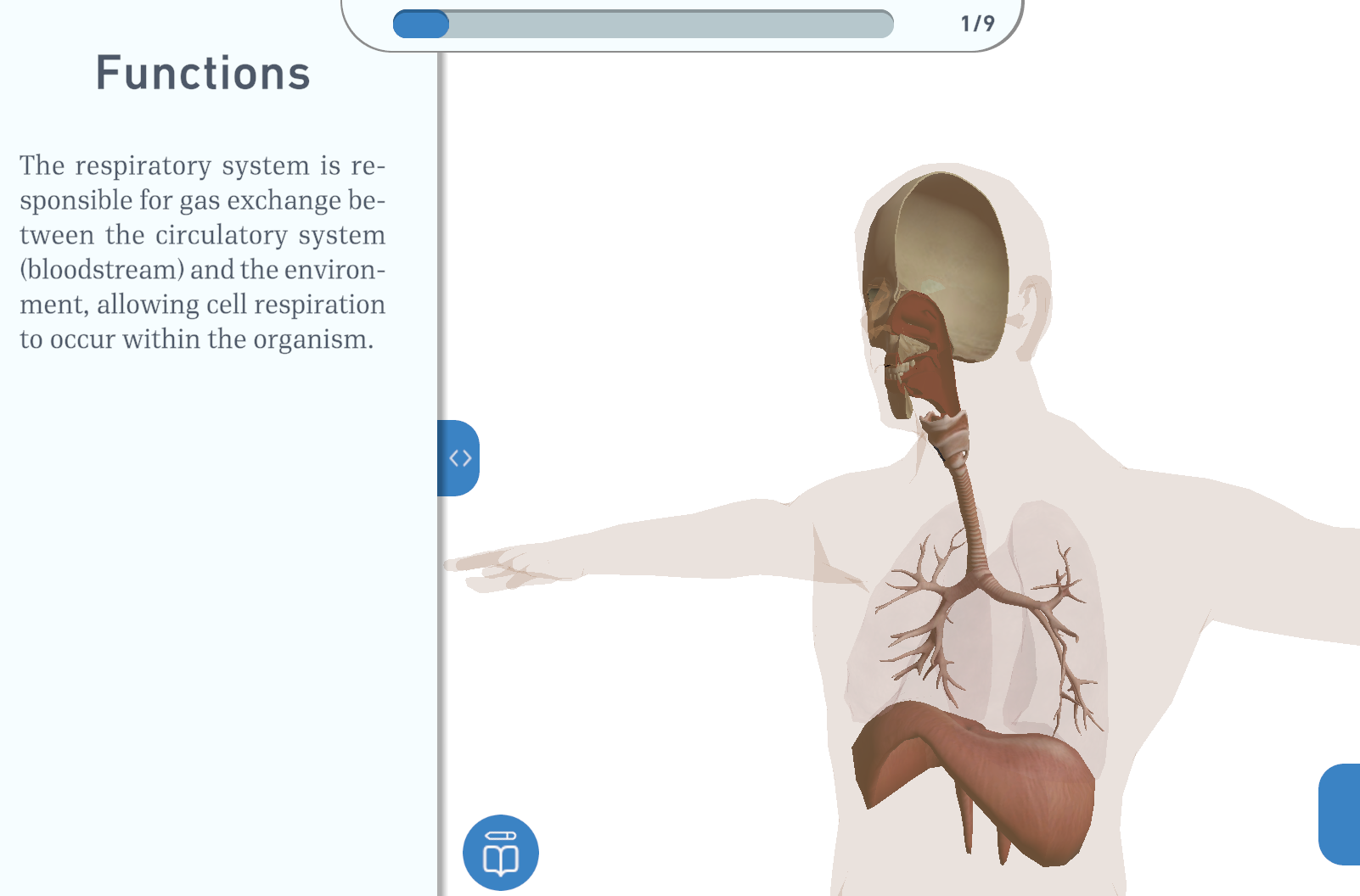
Observe the 3D model available in the app and notice:
- Which organs are part of this system?
- How does air enter and exit the body?
- What happens inside the lungs?
Reflect:
- Have you ever wondered why we cannot go without breathing?
- Can we breathe through both the nose and the mouth? Does it make a difference?
- What comes to mind when you think of the respiratory system?
Write down your hypotheses in your notebook before moving on.
💡 Teacher's tip:
Keep the responses visible throughout the trail and revisit them at the end to show how their understanding has grown.
Step 2 — Investigating
How Does the Respiratory System Work?
The respiratory system is the set of organs responsible for delivering oxygen to the blood and removing carbon dioxide from the body.
Based on the app lesson and your observations, answer the following:
- What is the main function of the respiratory system?
- Which structure carries out gas exchange with the blood?
- What is inhalation? What is exhalation?
The path of air: from inhalation to gas exchange
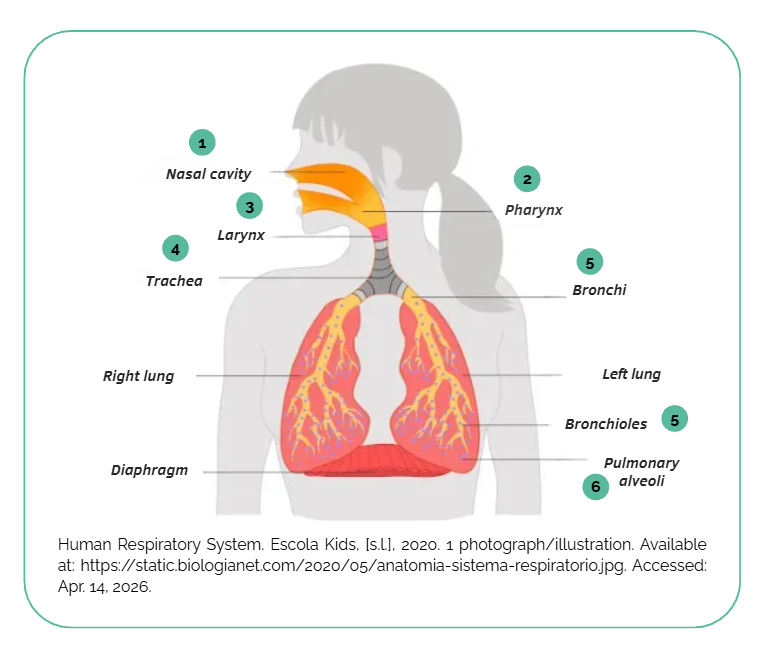
- Nasal cavities: filter, warm, and moisten the air.
- Pharynx: carries air from the nasal cavity to the larynx.
- Larynx: allows air to pass through and plays a role in voice production.
- Trachea: carries air to the bronchi.
- Bronchi and bronchioles: distribute air inside the lungs through progressive branching.
- Pulmonary alveoli: the site of gas exchange. Oxygen (O₂) passes into the blood, and carbon dioxide (CO₂) is expelled.
💡 Teacher's tip:
Encourage students to record their first impressions before learning the content.
Step 3 — Building Ideas
Muscles and the Mechanics of Breathing
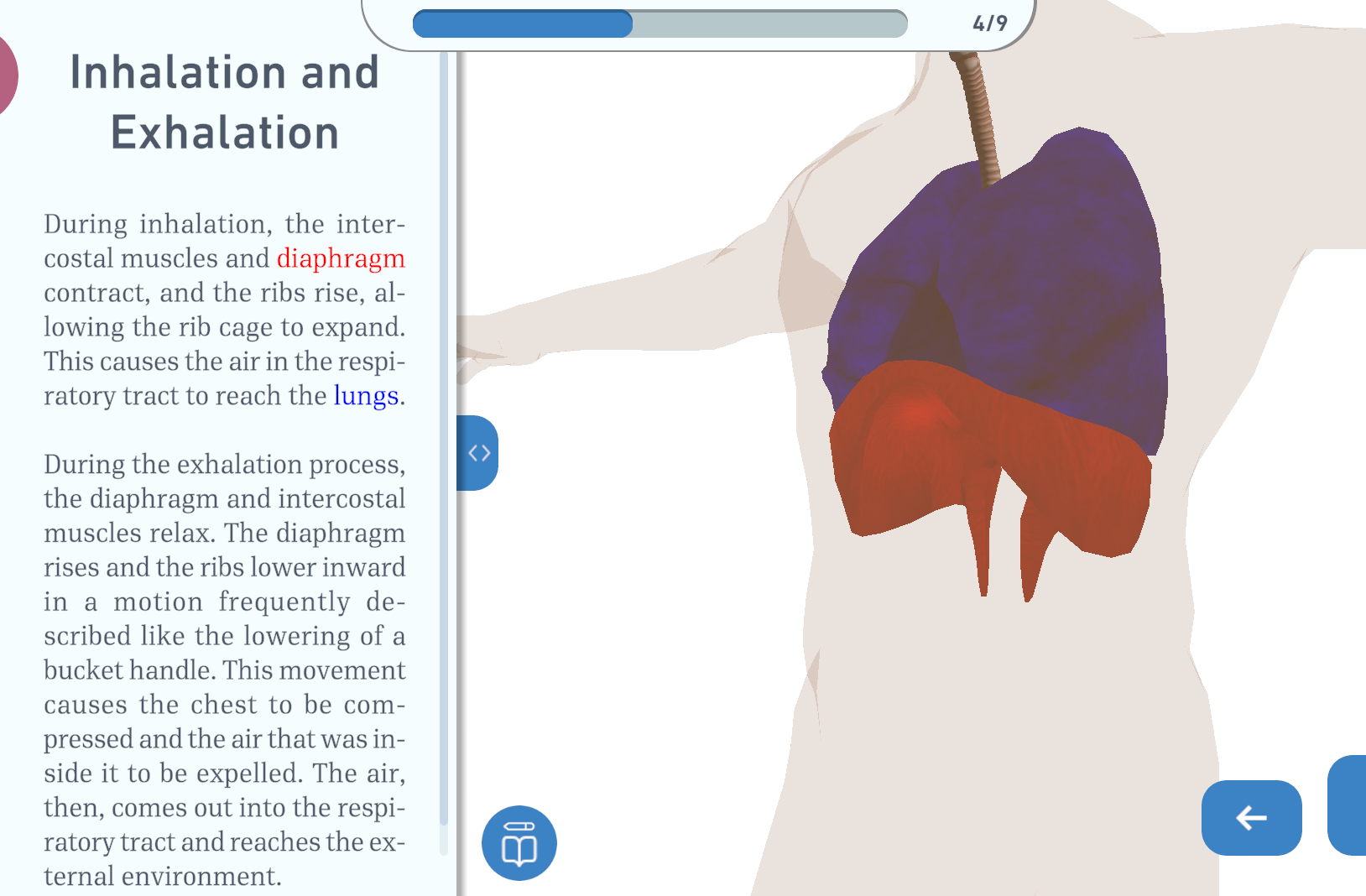
Breathing also depends on muscles. The two main ones responsible are:
- Diaphragm: a dome-shaped muscle located beneath the lungs. When it contracts, it moves downward, expanding the chest cavity and allowing air to enter.
- Intercostal muscles: located between the ribs, they help expand and compress the thorax.

Think about this:
- What would happen if the diaphragm stopped working?
- Why do we feel short of breath during intense exercise?
💡 Teacher's tip:
Ask students to connect the functioning of the respiratory muscles to concrete, everyday situations, such as feeling breathless after running.
Step 4 — Connecting the Dots
The Respiratory System in Everyday Life

Now, let's connect what you have learned to real-life situations. Read each scenario below and explain what is happening in the respiratory system:
- You are running and start breathing faster.
- You swallow something "down the wrong pipe" and begin to cough.
- You are in a polluted environment and feel irritation in your throat.
💡 Teacher's tip:
Have students explain each situation in their own words.
Step 5 — Leveling Up
Researching Respiratory Diseases
Choose one of the diseases or conditions below and research it:
- Asthma
- Bronchitis
- Smoking and lung cancer
- Air pollution and occupational diseases
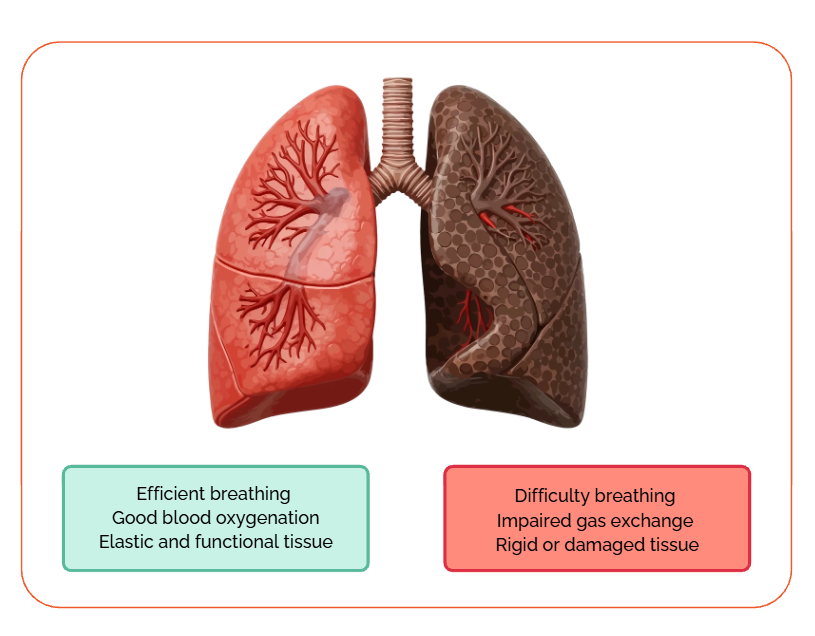
In your research, answer the following:
- Which part of the respiratory system is affected?
- What causes the disease or condition?
- Is there a treatment or form of prevention?
After completing your research, share your findings with the class.
💡 Teacher's tip:
Value the connections students make between the conceptual content and the real-life impacts of respiratory diseases. Promote the use of reliable sources in their research.
Throughout this Guided Learning experience, you:
- Learned about the organs of the respiratory system and their functions.
- Understood how inhalation and exhalation work in practice.
- Connected the functioning of the system to real-life situations.
- And investigated how diseases and habits affect respiratory health.
Have you ever stopped to notice that you breathe about 20,000 times a day without even thinking about it?
👉 Want to keep learning?
Access the quizzes in the app and deepen your knowledge of the respiratory system in Inspire Universe.
This material is protected by copyright. Reproduction, distribution, or sharing, in whole or in part, without authorization from Inspire Universe, is prohibited under Brazilian Copyright Law (Law No. 9,610/1998).

Copyright © 2025 | Universo Inspira