
Guided Learning
Understanding Our Skeletal System
Area: Science
Theme: The Skeletal System
Grade: 8th grade
Estimated time: ⏱️ 2 classes
👁️ Observation · 🔍 Investigation
Letter to the User
Guided Learning – Inspire Universe
Welcome to Inspire Universe's Guided Learning.
The Guided Learning tracks were created to help you organize your studies, deepen your understanding of the content, and turn scientific concepts into hands-on learning experiences.
Each track brings together structured activities, experiments, challenges, reflections, and investigative tasks that can be used in two ways:
- By the teacher, as a support tool for planning and delivering classroom activities;
- By the student, as a step-by-step study guide for learning inside and outside of school.
Here, learning goes beyond watching or reading: you are invited to observe, test, measure, compare, calculate, reflect, and connect ideas — developing essential scientific skills such as critical thinking, curiosity, and intellectual independence.
The activities were organized into thematic tracks, written in clear, accessible language, and designed to accompany you at every stage of your learning path, from your first contact with the topic to mastering the content.
At the end of each track, we invite you to keep exploring:
- Completing the quizzes available in the app.
- Revisiting the digital content.
- Deepening your understanding of the Universe and the scientific phenomena that surround us.
About the Use of This Material
This material is made available exclusively for educational use within the Inspire Universe platform.
Reproduction, distribution, commercialization, or sharing of this content, in whole or in part, by any means, without express authorization, is prohibited.
The responsible use of this material ensures that the educational, editorial, and scientific work involved in its creation is properly valued and allows us to continue developing new tracks, content, and learning experiences for you.
Evobooks Team
What will you learn?
You will get to know the components of the skeletal system beyond bones, understand the functions of structures such as cartilage, tendons, ligaments, and joints, learn about the division of the skeleton into axial and appendicular, and identify the main diseases that affect it, as well as ways to prevent them.
Why does this matter?
Understanding the skeletal system is essential for self-care, as it helps you make sense of how your body works and make more conscious choices related to health, nutrition, posture, and physical activity.
Step 1 — Exploring
Getting to Know the Skeletal System
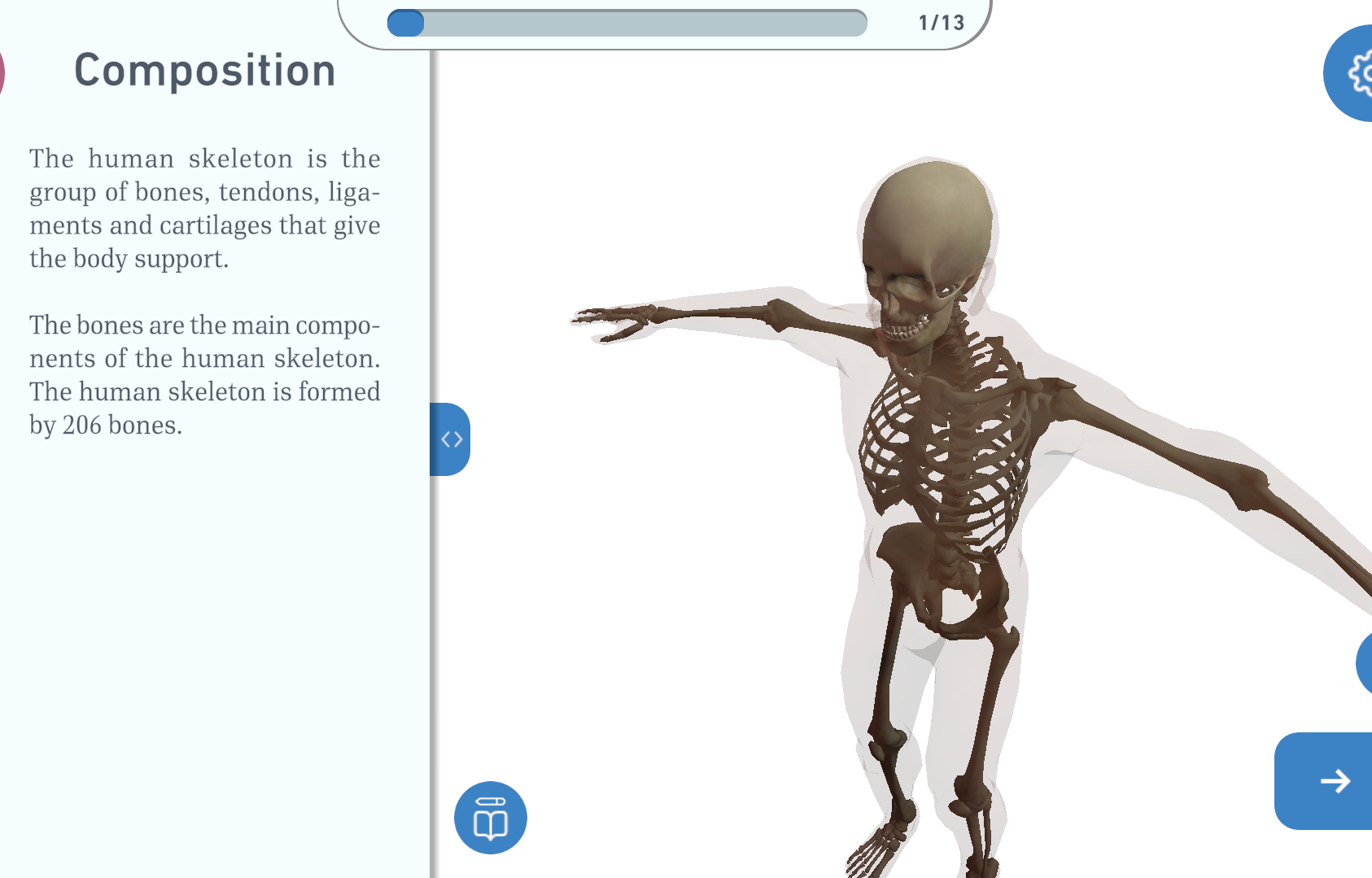
Think about it:
- What parts do you think make up the skeletal system?
- Are there other structures involved beyond bones?
- What functions do you think the skeleton performs in the body?
Write down your hypotheses in your notebook before moving on.
💡 Teacher's tip:
Encourage students to interact with the 3D model before any theoretical explanation. Answers should emerge from observation.
Step 2 — Investigating
What Makes Up the Skeletal System?
Based on the lesson in the app and your observations, reflect on the structures you examined:
- Where are cartilages located in the skeleton?
- Can you identify any tendons or ligaments in the 3D model?
- How many bones does the adult human body have?
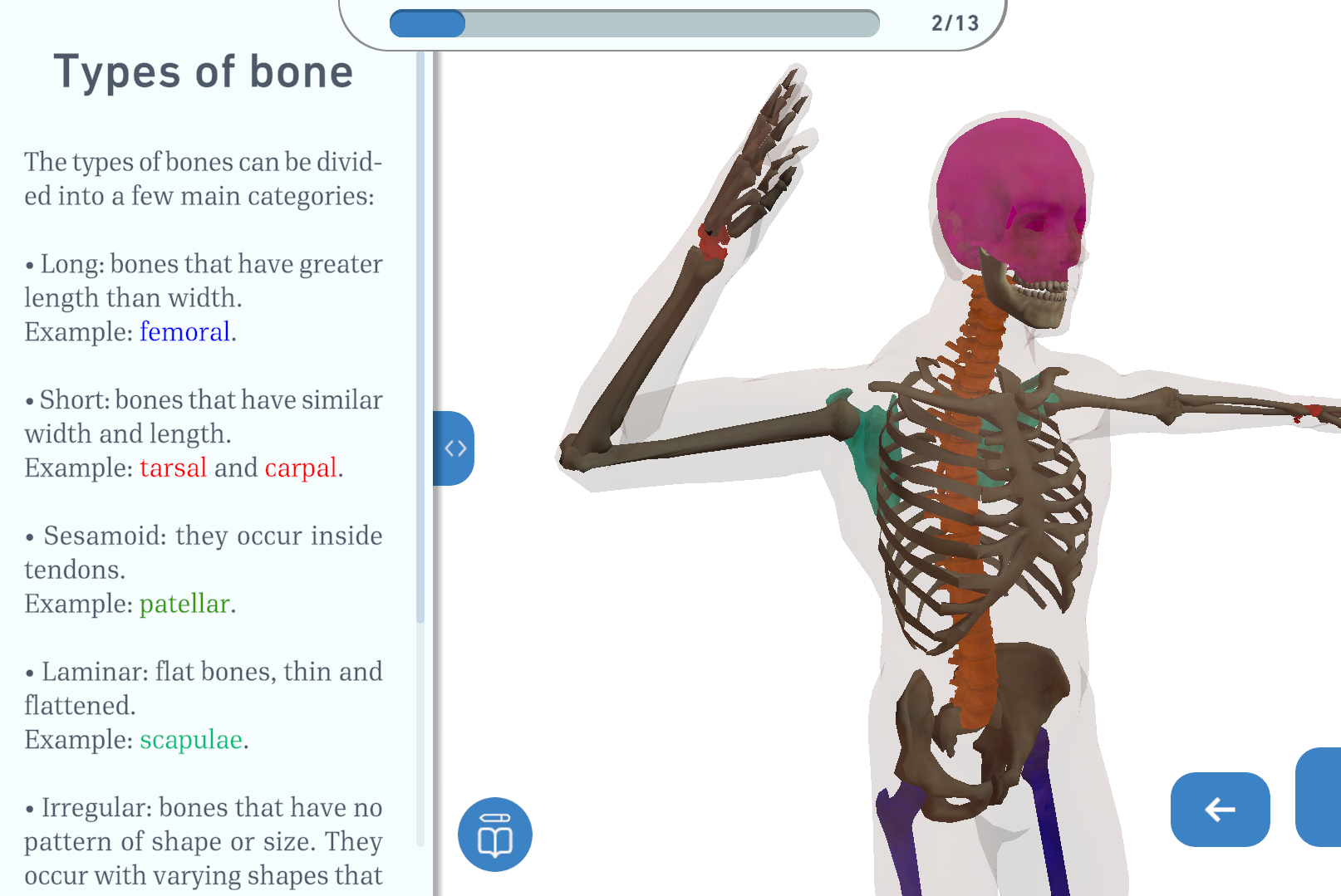
(After your investigation) The skeletal system is made up of a set of structures:
- Bones: provide support for the body, protect internal organs, and serve as anchors for muscles.
- Cartilage: flexible tissue that covers the ends of bones and forms structures such as the nose and ears.
- Tendons: connect muscles to bones, transmitting the force needed to move.
- Ligaments: connect bones at joints, providing stability without restricting movement.
- Joints: points where two or more bones meet, responsible for allowing different types of movement — or none at all, as in the fixed joints of the skull.
💡 Teacher's tip:
Return to the hypotheses from Step 1 and encourage students to compare their initial answers with the concepts they have now built.
Step 3 — Building Ideas
Sides and Divisions of the Skeleton
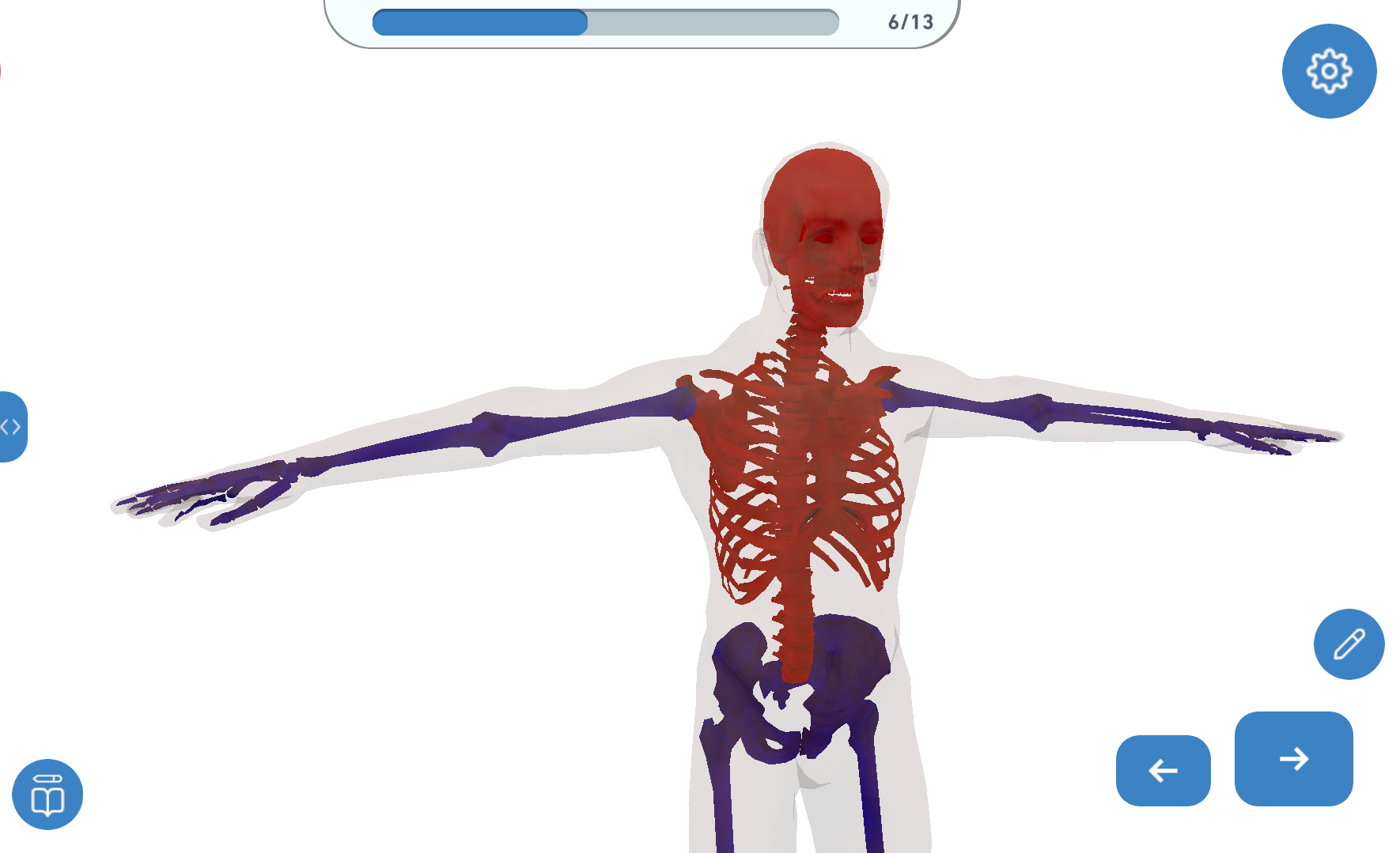
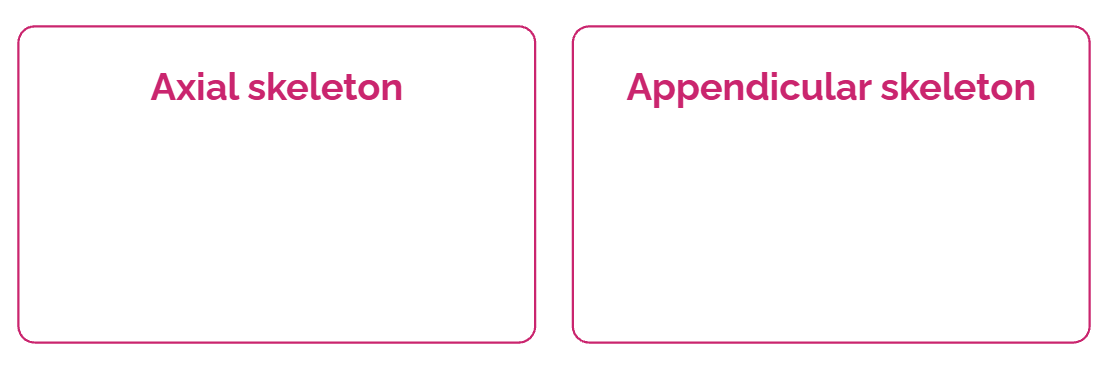
Look at the 3D model in the app and try to divide the skeleton into two groups before reading the explanation.
Reflect:
- The axial skeleton has approximately 80 bones, and the appendicular skeleton approximately 126. Which division did you expect to be larger? Were you surprised by the result?
- Point to your own body where each division begins and ends.
💡 Teacher's tip:
Ask students to gently touch their own bones as they identify the regions in the digital model. This reinforces self-awareness and makes learning more concrete and meaningful.
Step 4 — Connecting the Dots
Joints in Motion
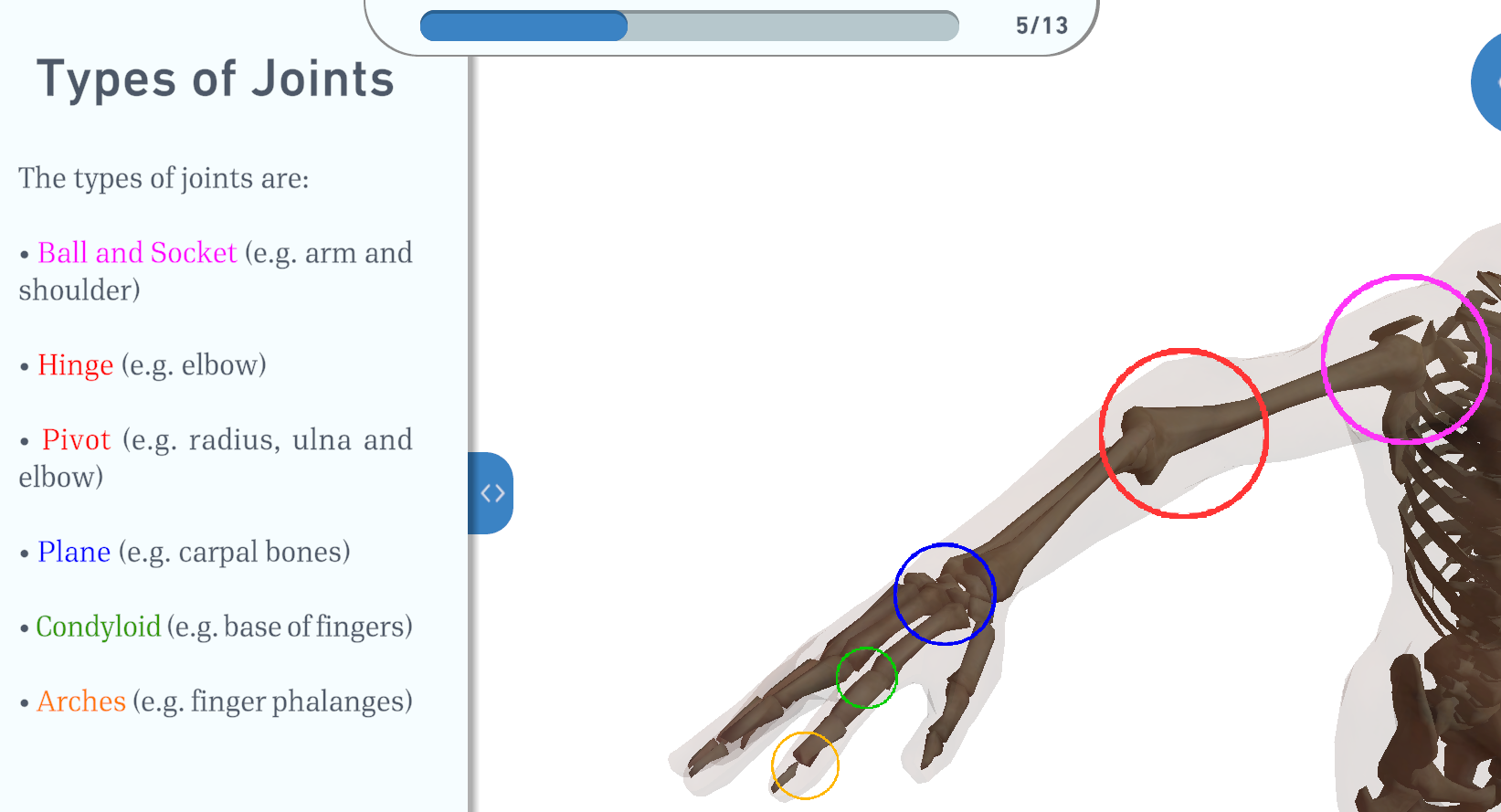
Every movement your body makes involves more than one structure at the same time:
- Mobile joints allow wide-ranging movements, such as running and throwing.
- Fixed joints protect vital organs such as the brain.
- Tendons and ligaments keep joints in place during movement.
Activity
Choose an everyday activity, such as brushing your teeth, typing, throwing a ball, or reaching for something on a high shelf. Using the 3D model, identify which bones and joints are involved in that movement and mark where those parts are located in the model.
💡 Teacher's tip:
Ask students to work in groups and allow 10 to 15 minutes for them to choose a sport or activity and identify the parts of the system involved. Each group should then put together a summary describing the chosen activity and the structures analyzed. Collect the summaries and lead a class discussion of the results.
Step 5 — Leveling Up
Identifying and Presenting Skeletal System Diseases
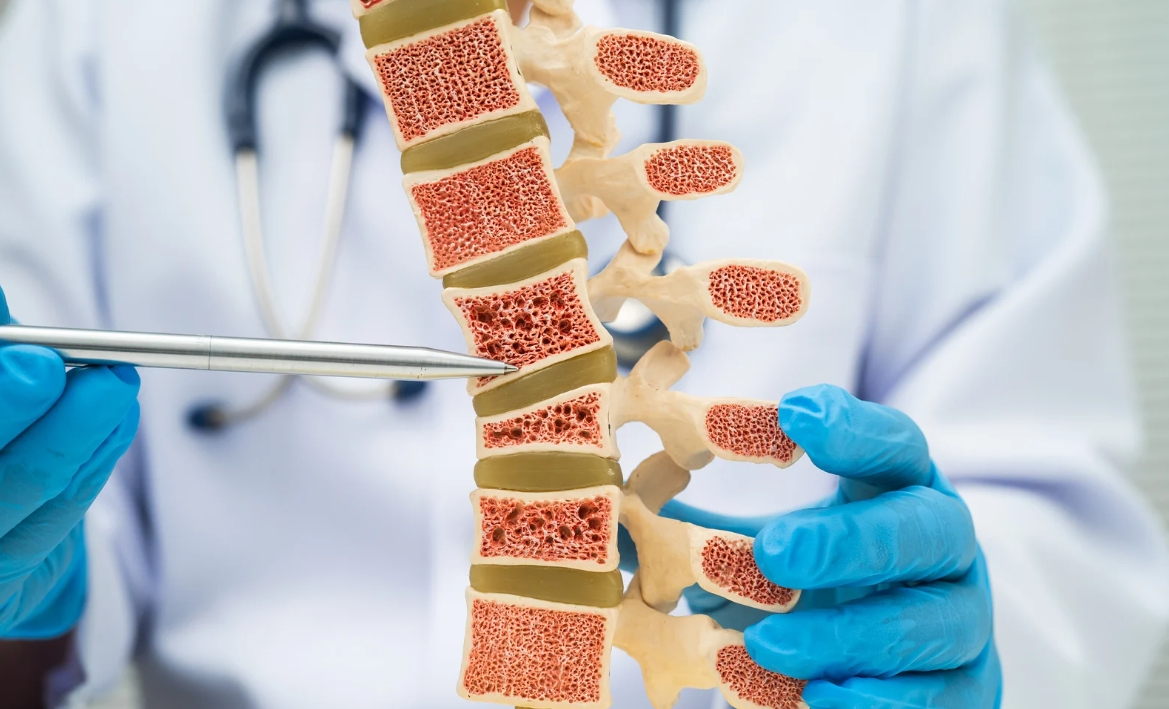
In groups, research the conditions in the table below and fill in the fields with the information you find. To guide your research, consider:
- What causes the condition
- How does it affect bones, joints, cartilage, ligaments, or tendons?
- What healthy habits help prevent or treat it?
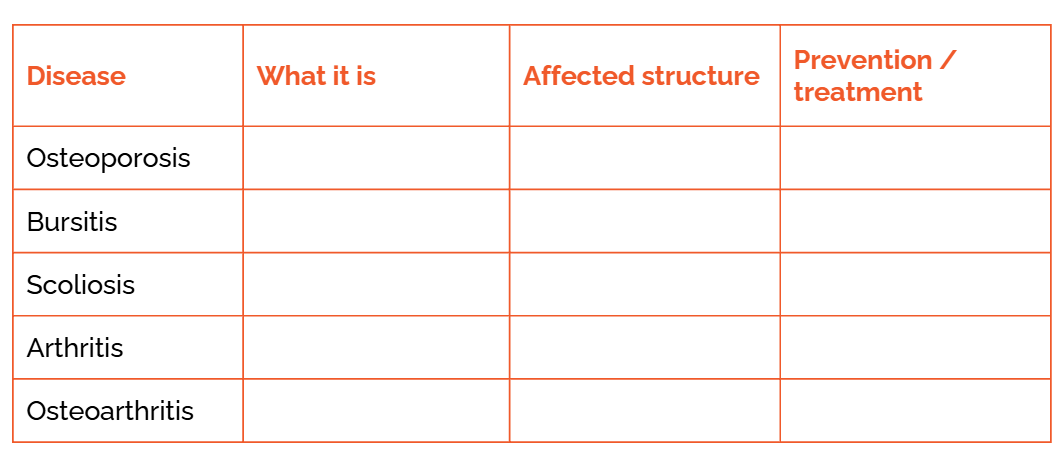
Once you have completed your research, present your findings to the rest of the class using the format of your choice: posters, flyers, slide presentations, or any other creative format.
💡 Teacher's tip:
Allow groups to prepare their presentations at home or in class, depending on the time available. During the presentations, encourage the class to ask questions; this stimulates active review of the content.
Throughout this Guided Learning experience, you:
- Explored the components of the skeletal system beyond bones.
- Investigated the functions of cartilage, tendons, ligaments, and joints.
- Identified in the 3D model which bones and joints are involved in everyday activities.
- researched diseases that affect the skeletal system and ways to prevent them,
- and applied these concepts creatively in a presentation.
Now, look at your own body: how many joints can you identify as you move around?
👉 Want to keep learning?
Access the quizzes in the app and deepen your knowledge about the human body on Inspire Universe.
This material is protected by copyright. Reproduction, distribution, or sharing, in whole or in part, without authorization from Inspire Universe, is prohibited under Brazilian Copyright Law (Law No. 9,610/1998).

Copyright © 2025 | Universo Inspira